Red Elephant Forest Walk
Do no harm. Leave only footprints.

The Red Elephant Forest Walk is one of 3 elephant walks in the Diepwalle State Forest. A 4th 18,2km walk is a combination of all three. I have called the red route the Red Elephant Forest walk as the trail is marked by a yellow plaque with a red elephant on it. So they can’t be removed by opportunistic souvenir collectors the plaques are nailed to the tree trunks high up and out of reach. At some point all the routes follow old forest paths created by generations of woodcutters who worked in the forest between 1776 and 1939.
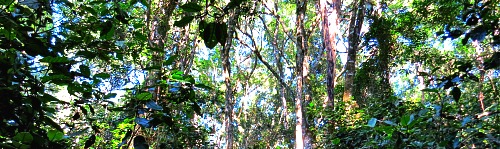
“Those who have experienced the forest in all its moods return home enriched. They do so in the knowledge that should man destroy the last of the forests, some of his inner peace, freedom and joy will be lost forever. The enchantment of the rainforest transcends its physical presence, leaving the human soul touched in mysterious ways that even science cannot explain” – Daleen Matthee All the trails begin at Diepwalle Information Centre where one needs to obtain a permit and map before beginning the trail of choice. A map is important because one can get very confused in the forest and an animal track can look like a path and before you know it, you are lost! The walks also overlap in a few places with the 7 day Outeniqua Trail. If you're not familiar with the area, it is anyway, inadvisable to walk alone. All the forest trails are different but I think that the Red Elephant forest walk is the most scenic of the three. It is 7kms long and involves quite a bit of uphill and down-dale before finishing with a fairly steep climb along the main dirt road back to the Information office. This forest walk is nonetheless very beautiful and rewarding. The names of these walks are reminiscent of the time when this magnificent forest was part of the territory of hundreds of elephants who roamed freely and fearlessly throughout the southern Cape.
Our Walkie Talkie walking club did the forest walk in March (2011) on a day that was quite cool to begin with. The beautiful Belladonna Lily was in full bloom. It’s also called the March Flower because....obviously....it blooms in March! By 10am however, a fair amount of humidity built up as the day-time temperature climbed. It took us a good three hours to walk the 7kms and we stopped for a refreshment break half way for at least ½ an hour.
The fairytale forest fungi are amazing and had us all oohing and aahing. It is said that J.R. Tolkien got inspiration from these forests when he was writing “Lord of the Rings”. Graceful fern fronds towered over our heads in places and we passed two awesome Outeniqua Yellowwoods on this forest walk as well. Tannin coloured streams had to be crossed a few times but well placed stepping-stones meant nobody got their feet wet.

We came to a designated picnic spot in a clearing at the edge of the forest before we crossed a road and plunged back into the deep shade of the tall trees and sweet smelling undergrowth again.
Throughout our forest walk the air rang intermittently with birdsongs, amongst them the trilling calls of the Sombre Greenbul, the fluid notes of the African Black-headed Oriole and the tsking sounds of sunbirds. We were fortunate to see a pair of African Olive Pigeons. (formerly called Rameron Pigeons.)
All too soon our forest walk was over and we were back at the Information Centre. Diepwalle has a tea-room and a well-stocked nursery of indigenous trees found in the area. We were told that Cape Nature is busy with a museum there too that will soon be opened to the public.

Forest Walk History Notes
The Woodcutters
The first woodcutters were employed by the Dutch East India Company in 1776. A Post was established for them at Swart Rivier in the George District. In those early days some of the woodcutters were of Scottish or English descent but they eventually merged with the Dutch-Afrikanner majority. Unschooled and isolated from society they lived miserable lives dominated by poverty. Living in crude huts made of reeds, clay and a mish-mash of other materials, they didn’t care to invest in good structures because they built in the forest on government land. They married young and inter-marriage was common. Close-knit and industrious, some never saw a town in their lifetime.

For more than 100 years the fiercely independent woodcutters suffered little interference from outsiders and worked the forests as they saw fit. They were masters of their craft with saw and axe but they were responsible for the indiscriminate and wasteful felling of many magnificent indigenous trees. Stinkwood (Ocotea bullata)was amongst the most popular. Others were varieties of yellowwoods, hard pear, red and white alder. The timber was used for shipbuilding, building materials, carts and wagons. For the first trains, the heavy ironwood was favoured for railway sleepers.
Forest management was unheard of and by the early 1800’s people were starting to see that the unbridled demand for timber was threatening the long-term survival of these forests! Ineffectual attempts to manage tree felling were made by individuals at different times. Johann Friedrich Meeding placed in charge of the Plettenberg Post allowed only woodcutters under contract to the Dutch East India Company to cut timber in the Knysna Forest. From 1778 until 1811 his controlled and protective measures reduced the haphazard and wasteful practices of the woodcutters.
Then for 14 years from 1811 – 1825 the British Navy were given control of the forests for the purposes of their shipyards. After that various local authorities without any experience allowed a growing population of woodcutters to recklessly exploit the forest reserves again.
A part time Conservator together with four forest rangers were appointed in 1847 to protect the Crown forests as they were closed to give them a chance to recover from the excessive exploitation they had undergone.
Eleven years later they were opened again and Civil Commissioners were authorised to issue woodcutters with licences. The system was open to abuse through corruption and once again the forests were wantonly plundered.
In 1856 Captain Christopher Harison, a committed and dedicated man, was appointed part-time conservator of the forests at Witelbosch in the Tsitsikamma.
He introduced a cyclic system of timber harvesting by dividing the forest into sections and systematically allowing each section a time to rest and regenerate.
In 1869 dry conditions precipitated a devastating fire that raged from Riversdale to beyond Humansdorp. The catastrophy galvanised the government to increase their supervision of the Crown forests. They consolidated the George, Knysna and Tsitsikamma Forests and Harison was appointed the first full-time Conservator of the forests in 1874.
The vastness of the forests combined with the Millwood gold rush that began in 1876 and lasted for roughly 17 years before it petered out, made forest management extremely difficult. Demand increased for wood for mining props and headgear. By 1885, 2000 diggers had pegged claims and 200 lived in tents around Millwood. A whole town emerged in the forest environment - fortunately it was short-lived.
Meanwhile, in spite of increasing restrictions the woodcutters stubbornly stuck to their trade refusing government attempts to encourage them towards other types of employment.
In 1880 the Count Mederic de Vasselot de Regne was appointed the Superintendent of Woods and Forests by the Cape government. During his 12 years in office professional forestry officers were employed under him. He published several manuals about forest management and timber harvesting. Under his guidance the first relatively quick-growing timber plantations were established to reduce the pressure on the indigenous forests.
By 1913 a new Forest Act required woodcutters to register to practise their trade. The register of that time reflects 1260 woodcutters. However, in 1939 when private woodcutting was finally stopped and the forests were closed, there remained only 258 woodcutters to be pensioned off by the government.
They were taken from the forests and relocated in communities within reach of schools, churches and medical facilities, The era of the woodcutters had ended but a few were able to continue employing their skills by working for commercial timber plantations.
Return from Red Elephant Forest Walk to Outdoor Activities
Return from Red Elephant Forest Walk to Discover Sedgefield Homepage
|